MBA Admissions • 2026 Guide
Stop Writing Generic SOPs: How to Write an MBA SOP That Actually Gets Noticed
Your CAT, GMAT or GRE score can open the door. Your SOP helps the admissions committee understand the person behind the numbers—your experiences, motivations, career direction and reason for pursuing an MBA.
The goal isn't to sound impressive. It's to sound specific, credible and unmistakably like you.
What Is an MBA SOP?
An MBA Statement of Purpose is a short essay that gives an admissions committee context that your resume and application form cannot. Depending on the institute, it may be called an SOP, personal statement or application essay, and the prompt and word limit can vary.
Your resume tells the committee what you studied, where you worked and what you achieved. Your SOP should explain what those experiences mean.
Resume vs SOP: The simplest way to think about it
Resume
What you did
→
SOP
Why it mattered
→
MBA Goal
Where it leads
01
What shaped you?
Identify the experiences that influenced how you think, work or choose your career direction.
02
What do you want next?
Explain your short-term goal and the reasoning behind it rather than simply naming a job title.
03
Why an MBA?
Show the gap between where you are today and the capabilities you need for your next step.
The Biggest Mistake: Writing a Generic SOP
There is a simple test for a weak SOP: remove your name and college and ask, “Could this essay belong to someone else?” If the answer is yes, it needs more personalisation.
| Generic | Personal |
|---|
| “My work experience helped me develop strong leadership and problem-solving skills.” | Describe the actual situation, what you did, what changed and what you learned from it. |
The stronger version gives the reader a situation, an action and an insight. It tells them something about how you think, not just what you claim about yourself.
How to Find Your SOP Story
Don't start by trying to write a polished introduction. Start with raw notes. Look across the parts of your journey that may have shaped your direction.
A
Academic journey
Why did you choose your undergraduate course? Was there a subject, project or teacher that changed your interests?
B
Work experience
Which problems did you enjoy solving? Did a project change how you understood an industry or function?
C
Extracurriculars
What did you lead, build or persist through outside academics that genuinely mattered to you?
D
Career interest
When did your intended career begin to appeal to you, and which experiences led you there?
E
The MBA
What skills, knowledge or exposure do you currently lack that you want to build?
PrepBee tip: Once you have your notes, identify the two or three experiences that best explain your journey. Those become the backbone of your SOP. Everything else is supporting detail—or gets cut.
Your SOP Is Not a Resume in Paragraph Form
Imagine your resume lists an internship, a college leadership role, case competitions, your first job and volunteering. Listing all five in an SOP doesn't automatically create a story.
Instead, ask: What connects these experiences?
Turn achievements into a narrative
Experience
→
Learning
→
Change in perspective
→
Future goal
That chain of reasoning is more valuable than an awards list because it helps the reader understand how your experiences influenced your choices.
How to Write a Strong “Why MBA?”
“I want global exposure,” “I want to improve my leadership skills” and “I want to learn from a diverse peer group” may all be true. But they don't fully answer the question: Why do you need an MBA?
Build your Why MBA in four questions
1
What next?
What do you want to do after the MBA?
2
What's missing?
What currently stops you from doing it?
3
What must you build?
Which specific capabilities do you need?
4
Why an MBA?
How will the programme help you close those gaps?
For example, an engineer in operations who wants to move into product strategy might identify gaps in market analysis, financial thinking and cross-functional leadership. In that case, the MBA becomes a logical next chapter—not simply a two-year pause between jobs.
Don't Just State a Career Goal. Explain It.
“I want to work in consulting.” “I want to enter investment banking.” “I want to become a product manager.”
These are destinations, not stories.
What experience made you interested in this field?
What problems do you enjoy solving?
What exposure influenced your choice?
Why does this goal make sense given your past?
You don't need a 20-year plan. A stronger SOP connects your past to your short-term post-MBA goal and gives a broad sense of your longer-term direction.
“Why This B-School?” Needs Research, Not Flattery
This is where many SOPs start sounding like brochures: “world-class faculty,” “diverse peer group,” “excellent infrastructure” and “strong alumni network.” Almost any B-school can be described that way.
Instead, research the institution and connect specific elements to your goals:
Curriculum
Courses, electives and specialisations.
People
Faculty, alumni and student communities.
Experiences
Case competitions, live projects and industry interaction.
Global exposure
Exchange and international opportunities.
Career ecosystem
Industry pathways and placements.
Pedagogy
What is distinctive about the programme structure?
The replacement test: Replace the school's name with another B-school. If your paragraph still works, it probably isn't specific enough.
Should You Mention Your Achievements?
Yes—but don't turn the SOP into an awards list. The best achievements are the ones that help the admissions committee understand something about you.
Leadership
Shows how you work with people.
Failure or setback
Shows how your thinking changed.
Internship
Can explain where a career interest came from.
Competition
Can show how you approach ambiguous problems.
The better question isn't “What is my most impressive achievement?” It is “Which experience helps the admissions committee understand me better?”
A Simple MBA SOP Structure You Can Adapt
There is no single correct structure. Always follow the specific format and prompt given by the institute. If you need a starting framework, this flow works for many applicants:
01
Opening
A specific moment
02
Background
Formative experiences
03
Career direction
Short-term goal
04
Why MBA
Capability gaps
05
Why this school
Specific fit
06
Closing
What you contribute
Start with something concrete rather than a generic quote. Show what shaped your interests, explain your career direction, connect the MBA to your capability gaps, demonstrate why the particular school fits, and close with what you can contribute to the class and community.
Why Multiple SOP Reviews Matter
After spending hours on an essay, it becomes difficult to see its weaknesses. You know what you meant to say; the reader only sees what you actually wrote.
01
Friend
Can tell you whether the essay sounds natural and genuinely like you.
02
Senior or colleague
Can challenge whether your career plan and reasoning are convincing.
03
MBA application reviewer
Can spot generic “Why MBA?” answers or a vague B-school rationale.
Use feedback, but don't let other people rewrite your story. You should still own every line and be able to defend it in an interview.
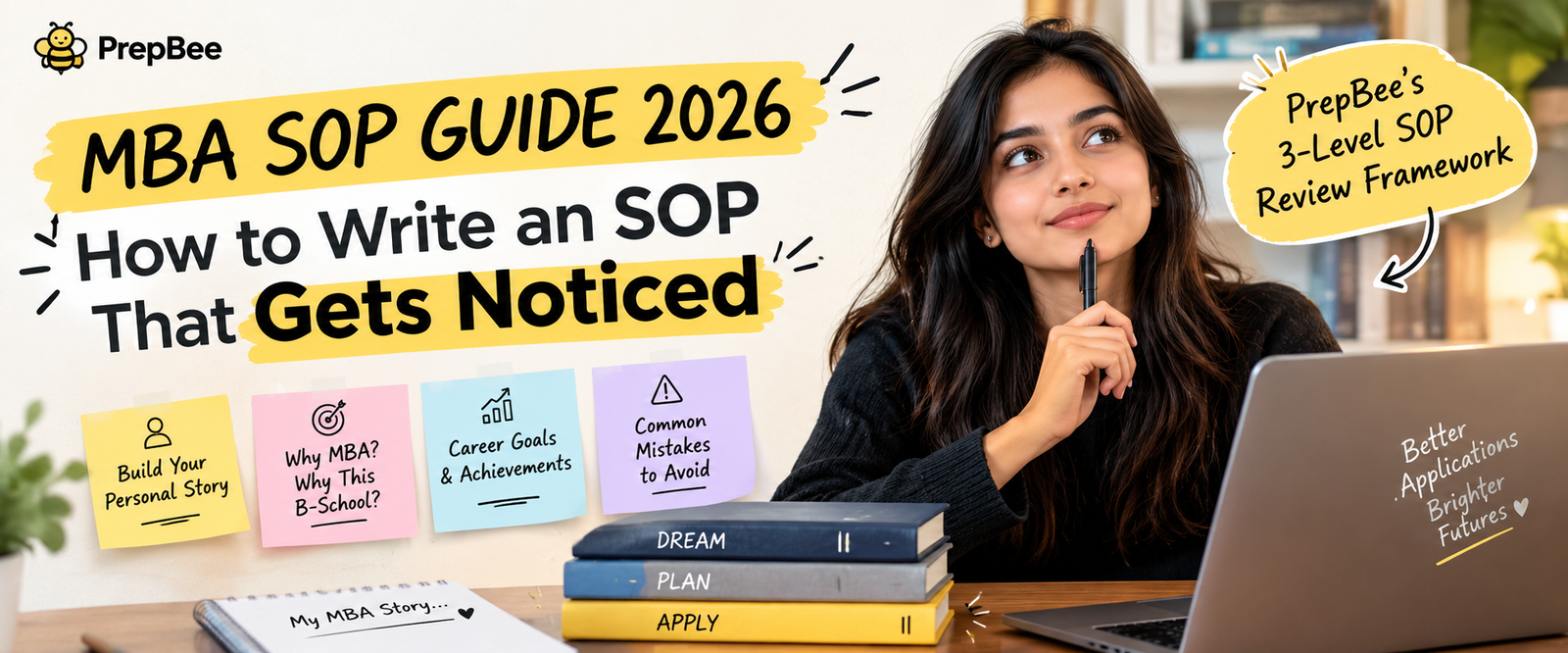
PrepBee's 3-Level SOP Review Framework
At PrepBee, the SOP review approach focuses on three different layers so that feedback goes beyond grammar and vocabulary.
1
Personalisation & Story
Does the SOP reflect the applicant? Is the story authentic? Are stronger experiences available? Does it sound like the person rather than a template?
2
Content & Structure
Does the essay answer the prompt? Is there a clear thread connecting past experiences, career goals and the MBA? Is the school rationale specific?
3
Mentor Review
An experienced mentor reviews the SOP from an admissions perspective, checking clarity, positioning, unsupported claims, gaps and overall impact.
10 MBA SOP Mistakes to Avoid
Opening with a generic quote that has nothing to do with your story.
Repeating your resume instead of adding context to it.
Stating career goals without explaining how you arrived at them.
Giving a vague “Why MBA?” based only on exposure, leadership and networking.
Copying language directly from the B-school website.
Using complicated vocabulary just to sound impressive.
Calling yourself “passionate,” “resilient” or “innovative” without evidence.
Trying to make your story sound perfect instead of handling setbacks honestly.
Getting feedback only on grammar and spelling rather than story and logic.
Letting too many people rewrite the essay until it no longer sounds like you.
The Final SOP Test
Before submitting, read your SOP aloud and ask:
“Would I actually say this in an interview?”
If you wrote that you are passionate about entrepreneurship, can you explain where that interest came from? If you want to be a strategy consultant, can you explain why? If you call a particular school your ideal choice, can you explain exactly why?
Interviewers may draw questions from what you have written. Every important statement should therefore be something you can defend, explain and expand on. Your SOP should not create a fictional version of you. It should present the clearest, most thoughtful version of the real you.
MBA SOP FAQs
How long should an MBA SOP be?
It depends on the institute. Word limits and prompts differ, so always follow the school's instructions. If no limit is given, aim to be focused and concise rather than trying to cover everything.
Can I use the same SOP for multiple B-schools?
You can reuse the core story, but your “Why MBA?” and “Why this school?” sections should be tailored to each institute. An untouched copy can easily become generic.
How is an SOP different from a resume?
A resume lists what you did. An SOP explains why you did it, what you learned and how it connects to your future goals.
Should I mention weaknesses or failures?
If a setback genuinely shaped your thinking, you can mention it. Focus on what you learned and how you changed rather than simply describing the failure.
How early should I start writing my SOP?
Start early enough to draft, get feedback from more than one person, revise, and put the essay away for a few days before the final read. Rushed SOPs tend to become generic.
Can AI tools write my SOP?
AI tools can help brainstorm or tighten language, but a generated essay can lack the specific personal detail that makes an SOP credible. You should be able to discuss every line in an interview. Use tools for support—not for your story.
Your Story Matters More Than the Template
There is no magic opening line that guarantees an interview call, and there is no universal SOP structure that works for every applicant. What matters is whether your essay answers the question, shows self-awareness, connects your past with your future and gives the admissions committee a reason to remember you.
Make Your SOP Sound Like You—Just Sharper.
PrepBee's SOP support combines personalisation, structured feedback and mentor review to help MBA applicants strengthen their essays while keeping their own voice.
Explore PrepBee SOP Support